
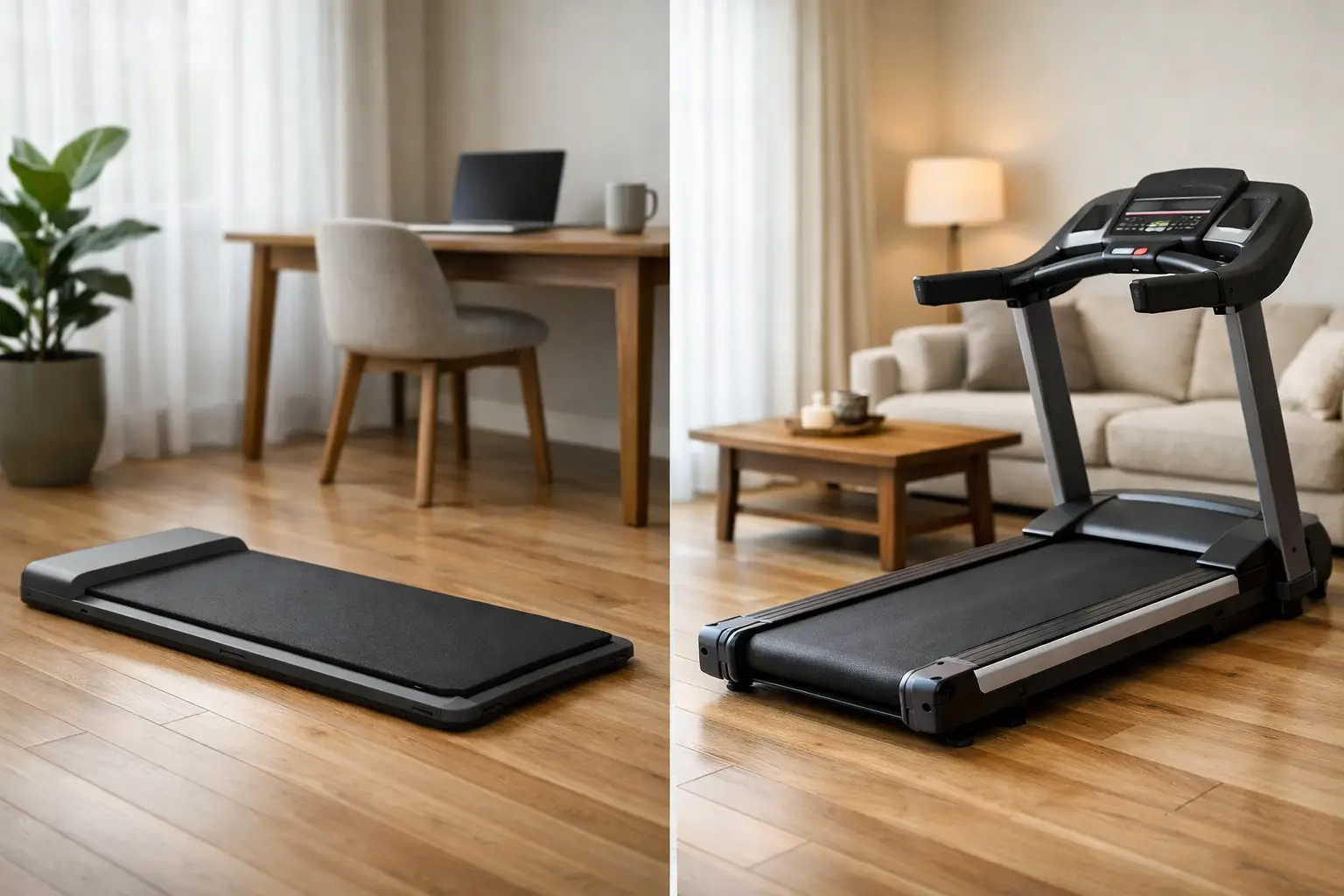
A beautiful home supports the way you want to live, from a calm morning coffee ritual to a more energized workday. When comparing a walking pad vs treadmill, the right choice is less about which machine is objectively better and more about how it fits your space, schedule, and preferred version of movement.
Both can make daily activity feel more accessible without a gym commute. Yet they create very different experiences. One is discreet and compact enough to tuck beneath a console table or bed; the other is a dedicated fitness centerpiece built for longer, faster, and more varied training.
A walking pad is a slim, streamlined walking machine designed primarily for low-impact movement. Many models have no upright handlebars, while others include a foldable rail for extra support. Their restrained profile makes them especially appealing for apartments, home offices, and multipurpose rooms where visual calm matters as much as function.
A traditional treadmill is a fuller exercise machine with a larger running deck, a console, handrails, and usually more powerful motor performance. It is made for walking, jogging, and running, often with higher top speeds and incline settings. In exchange for that capability, it claims more room and tends to be noticeably heavier.
Think of a walking pad as a beautifully practical daily companion. It is ideal for adding steps while catching up on emails, watching a favorite show, or taking a gentle reset between tasks. A treadmill is the more complete training station, suitable for anyone whose routine includes structured cardio sessions or a real running habit.
The appeal of a walking pad is immediate: it makes an active lifestyle feel possible in rooms that were never designed as a home gym. Many are low-profile enough to slide under a bed, sofa, or elevated storage unit after use. That convenience can matter more than a long list of performance features when your home is thoughtfully furnished and every square foot has a purpose.
For the work-from-home shopper, an under-desk walking pad can turn passive screen time into a more active afternoon. Gentle walking may feel easier to maintain than a separate, scheduled workout, especially for people who spend much of the day seated. It also offers a lower-pressure way to begin a consistent movement routine.
Walking pads are typically quieter than larger treadmills at walking speeds, though quiet does not mean silent. The belt, motor, and footfall will still create sound, particularly in an upstairs apartment or on hard flooring. A quality exercise mat can help protect floors and soften vibration while giving the setup a more finished, intentional appearance.
The trade-off is performance range. Most walking pads are designed for a leisurely to brisk walk rather than a true run. Some offer a faster mode with a raised handle, but speed limits, deck length, and motor capacity can still make them less comfortable for longer strides. If you know you want to train for a 5K, a walking pad will likely feel like a temporary compromise.
A walking pad suits a home where storage is limited, decor is a priority, and movement needs to blend into daily life. It is a particularly polished choice for light cardio, recovery walks, step goals, and desk-based routines. It can also be a smart option for beginners who want an approachable, low-impact way to build momentum.
Before purchasing, measure the open floor area and the storage area, not just the machine itself. Leave enough clearance to step on and off safely, and confirm your furniture has sufficient space underneath if that is where the pad will live. Check the stated user weight capacity, belt dimensions, remote or app controls, and whether a safety key is included.
A treadmill is for the person who wants at-home cardio to feel more like a complete workout experience. Its larger deck provides more confidence at faster speeds, while handrails and a visible display can make the machine feel more supportive and structured. For runners, these details are not luxuries. They are central to comfort and safety.
The best treadmills offer speed variation, incline options, preset workouts, heart-rate compatibility, and more stable frames. Incline is especially valuable because it changes the character of a walk without requiring a run. A steep walk can add intensity for someone who prefers low-impact training but still wants a challenging session.
That versatility makes a treadmill a better long-term investment for households with different fitness preferences. One person can take a gentle morning walk while another uses it for intervals or distance running. If your equipment needs to serve several adults, a treadmill’s wider range may justify the extra cost and permanent floor space.
Still, larger does not automatically mean better. A treadmill can overwhelm a bedroom, office, or living area if it is chosen without a plan. Consider it as you would a substantial furnishing: assess scale, access to power, ceiling height if incline is involved, and whether its finish complements the room. A folding treadmill can reduce its visual presence between sessions, though it will rarely disappear as completely as a walking pad.
Choose a treadmill if running is already part of your life, if you want guided cardio with room to progress, or if you value incline training. It is also the stronger choice for taller users or anyone who feels unsteady on a narrow belt. The extra deck length and sturdier frame can create a more secure, natural stride.
Review motor specifications carefully, but do not let one number make the entire decision. A smooth belt, reliable warranty, stable deck, sensible controls, and comfortable cushioning often matter more in everyday ownership. Consider the assembled dimensions and machine weight as well. Delivery is one thing; repositioning a heavy treadmill later is another.
Your fitness equipment must work with your home, not merely fit inside it. A compact walking pad is easier to conceal, but a treadmill may be used more consistently if its console, programs, and sturdier feel make each session enjoyable. The machine that complements your habits is the one most likely to become part of your routine.
Noise deserves an honest assessment. A walking pad at a gentle pace is often the more considerate choice for close neighbors, sleeping children, or shared walls. A treadmill can be perfectly manageable in the right setting, but running creates greater impact. If possible, place either machine on a supportive mat, avoid uneven surfaces, and choose a room where vibration is least likely to disrupt the household.
Aesthetics also shape consistency. An elegant home does not require hiding every practical item, but it benefits from purposeful choices. Select a machine in a clean, neutral finish, keep cords organized, and give it a designated place rather than allowing it to become a temporary obstacle. The most luxurious routine is one that feels effortless to return to.
Start with the movement you will realistically do most often. If you picture yourself walking while answering messages, listening to a podcast, or easing into the day, a walking pad offers exceptional convenience. If you picture planned workouts, sweatier sessions, hill walks, and running progress, a treadmill gives you more room to grow.
Then consider the cost of unused space. A treadmill may offer every feature you want, but it is not the ideal purchase if it makes your room feel crowded or requires constant rearranging. Conversely, a walking pad may be exquisitely compact yet leave you wishing for more intensity within a few months.
For many homes, the decision is wonderfully simple: choose the walking pad when daily, unobtrusive movement is the priority; choose the treadmill when performance and training flexibility lead the list. The right piece should feel like a refined invitation to care for yourself, waiting quietly for the next moment you are ready to move.









Leave a comment